How blown-in insulation works
Loose-fill insulation is blown into horizontal surfaces or enclosed cavities using a hose and machine. The material fills every gap around joists, cables and chimneys where boards would never fit, creating a continuous layer without joints. No demolition is required; only small holes for the hose are needed. A typical family home is completed in one working day.
Where it fits
- Ceiling under an unused attic: the most common and fastest saving on a house. Layer 30 cm and more, walkway to the chimney above the insulation.
- Cavities in timber beam ceilings in older houses where there is an empty space between the floor boarding and the ceiling.
- Sloped and double-skin flat roofs, which are inaccessible with boards.
- Wall cavities for timber-frame buildings and houses with ventilated cavities in the masonry.
Cellulose, mineral or wood fibres
Loose-fill cellulose insulation It is made from recycled paper with added borate salts to resist fire and mould. It effectively absorbs and releases moisture, making it suitable for timber structures. Mineral fibres They are non-combustible (Class A1), do not settle and are unaffected by moisture; they are selected for attics with chimneys and where fire resistance is critical. Wood fibre insulation It is suitable for vapour-permeable assemblies and timber-framed buildings. We recommend the material based on the construction, not on what we happen to have in stock.
Sprayed insulation
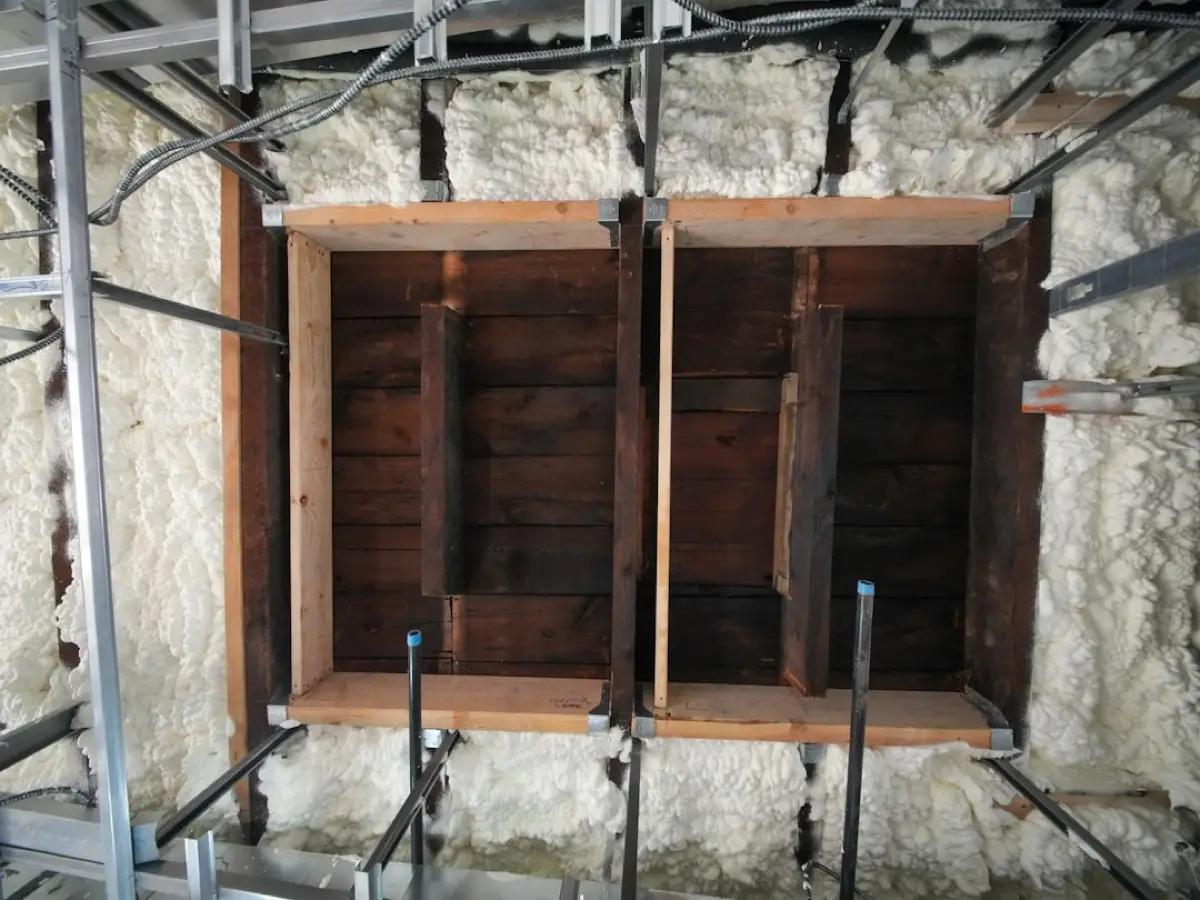
For irregular and hard-to-reach areas, the underside of roof coverings, or garage and cellar ceilings, we use sprayed PUR foam. Open-cell foam remains breathable and is suitable for under-roof applications; closed-cell foam offers higher insulation performance and resists moisture, making it ideal for basement and plinth ceilings. Spraying requires precise adherence to substrate temperature and layer thickness, so we only carry it out with certified application.
What we pay attention to
- Assessment of the electrical installation and chimney condition in the cavity prior to blowing; self-heating cables must not remain in the insulation without a protective device.
- Checking the layer thickness with gauges at several points and recording the results in the handover protocol.
- Vapour barrier or vapour retarder on the interior side, depending on the ceiling type.
- Ventilation of the attic space above the insulation to prevent moisture condensation under the roof covering.
The price of blown insulation is determined by the area, required thickness, selected material and accessibility. We describe what affects it for your house on the page insulation priceInsulation of the ceiling below the attic is also among the measures supported by the programme Nová zelená úsporám.
Frequently Asked Questions
Does blown-in insulation settle over time?
Mineral fibres do not settle. Cellulose is applied with an additional amount for settling, as specified by the manufacturer for horizontal and vertical application, so that the required layer remains even after years.
Can you walk on a loft after blown-in insulation has been applied?
No, not after the insulation itself has been laid, as it would be compacted. We install a walkway or a grid with planks above the insulation level to access the chimney and dormer windows.
How much does blown-in insulation cost?
It depends on the area, thickness, material and access to the attic. After inspection you will receive a fixed itemised estimate; the price will not change.
Is cellulose flammable?
Cellulose is treated with borate salts; in the event of fire it smoulders and does not spread flames. Where fire class A1 is required, for example around a chimney, we select mineral fibres.